How behavioral design drove a 20x uplift in professional profile activation
Product & Behavioral Designer • PropTech / SaaS • UX/UI · Behavioral Design · Product Strategy

Overview
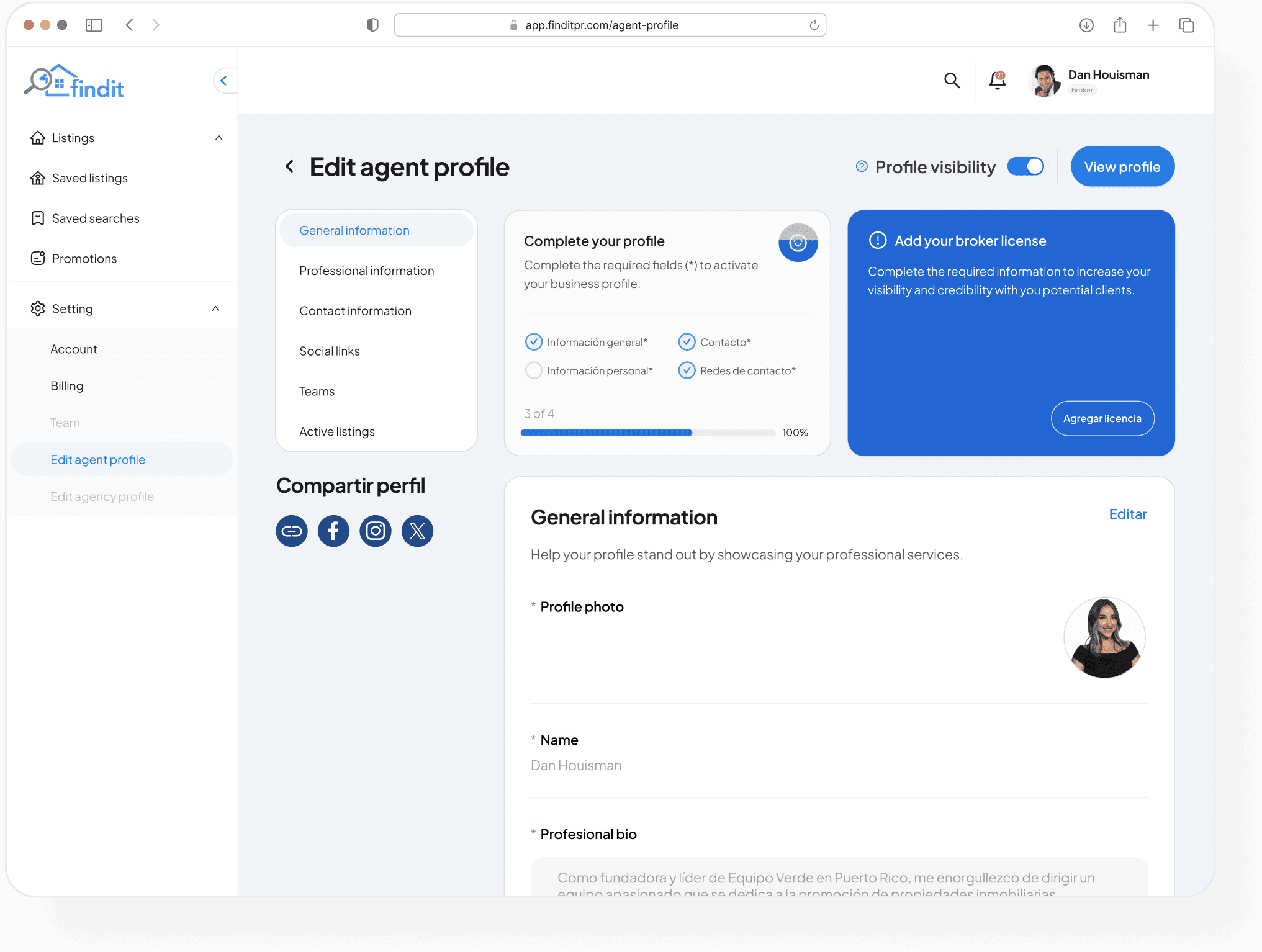
Findit is a PropTech marketplace where real estate agents and agencies showcase listings and connect with potential clients. Despite offering a professional profile feature — one indexed on Google and central to credibility — most users registered and never activated it.
I led the redesign of the Profile Activation Flow, applying the COM-B behavioral model to diagnose barriers and design targeted interventions. The result was a 20x increase in profile activations in the following user cohort.
My role
Founding Product Designer + Behavioral Design Strategy
SCOPE
UX Strategy · Behavioral Design · Interaction Design · UX Copy
I collaborated closely with the PM, Brand Manager and engineering to align activation goals with business constraints and implementation feasibility.
Problem
The business problem was clear: an inactive profile base meant a weaker marketplace. But the design problem was more nuanced. Users weren't avoiding the feature out of friction alone. They didn't understand its value, didn't feel compelled to act, and had no moment that made completion feel urgent or rewarding.
Behavioral Challenge
How might we motivate brokers to complete their professional profiles by making the value of visibility and credibility feel more immediate and worth the effort during onboarding?
What behavior we changed
The redesigned onboarding experience significantly improved profile activation behavior, increasing completed professional profiles by more than 20x during the observed period.
This strengthened broker visibility, marketplace trust, and overall participation within the platform.
20x
uplift in profile activations in the following user cohort
3→70
active profiles; feature adoption remained consistent among long term users.
COM-B
behavioral model applied to diagnose barriers and design targeted interventions
Context
The initial brier inside the business was design the profile agent flow and redesign the directory.
However, after reviewing the experience more deeply, it became clear that the problem was behavioral rather than purely usability or operational.
Business problem
Real estate agents were not activating their profiles within the first days after registration, reducing marketplace visibility and affecting the overall supply and credibility of the platform.
Behavioral assumptions
Before starting to design, it was important for me to align assumptions with the team to define key hypothesis since the product was in early stage and we need to launch an experiment.
Based on analytics, stakeholder input, and informal user feedback, we identified four assumptions behind low profile activation:
1. Users did not associate profile completion with business outcomes
Many agents viewed the profile as administrative setup rather than a visibility and trust mechanism.
2. Effort perception was higher than expected value
The amount of information requested felt disproportionate compared to the perceived short term reward.
3. Users postponed activation
Because profile completion was not urgent, many users intended to “finish later” but never returned.
4. Different agent types had different motivations
Independent agents and agency managers approached onboarding differently, requiring different messaging and guidance priorities.
Why this behavior mattered
I needed to understand why profile activation mattered as a core behavior… not just for users, but for the business.
Complete profiles built trust and reduced friction when buyers contacted agents, improving lead quality.
Activating the profile increased both agent and platform visibility, since profiles were indexed on Google.
The number of active profiles served as a proxy for marketplace health — more visible agents meant more listings, interactions, and perceived value.
Once agents invested effort in completing their profiles, they were more likely to stay and engage — strengthening retention.
Understanding the barriers: COM-B analysis
I mapped behavioral barriers using the COM-B framework. Not as a theoretical exercise, but as a diagnostic tool to identify exactly what prevented users from activating their profiles. Each dimension pointed to a different type of intervention.
CAPABILITY
Users lacked awareness and mental models of the profile feature. They didn't recognize it as part of their workflow or undestand its purpose.
Intervention needed
Education and context at the right moment.
MOTIVATION
Users didn't emotionally or cognitively associate the profile with personal gain. Completing it didn't feel rewarding or essential to their success.
Intervention needed
Reframe the value proposition. Make the benefit explicit before asking for effort.
OPPORTUNITY
The system didn't surface moments that naturally encouraged completion. No contextual triggers, no urgency, no relevance cues.
Intervention needed
Design right momento of exposure -
USER SEGMENT
Independent Agents: individual professionals seeking personal visibility and credibility among potential buyers.
Agencies or Agency Managers: responsible for multiple agents, focused on brand positioning and team management efficiency.
TARGET BEHAVIOR
"Users activate and complete their professional profile within the first three days after registration."
BEHAVIORAL GOAL
+5% increase in profile activations within 90 days. We set a conservative target because we had no historical baseline. The actual result +20%, reflected both the depth of the behavioral gap and the effectiveness of the interventions.
BEHAVIORAL HYPHOTESIS
We hypothesized that reducing behavioral friction, improving guidance, and reframing the value of profile completion would increase the number of agents who completed their professional profiles during early onboarding.
The strongest barrier was motivational.
Many users did not perceive profile completion as immediately valuable. Since the benefits were delayed and abstract, users deprioritized the task or abandoned it entirely.
Behavioral Interventions
Before moving into high-fidelity design, I created low-fidelity sketches to map out the key user flows and refine the UX copy that would guide behavior. Through iterative sessions with the CEO, CTO, and Marketing team, I validated the tone, order, and logic of each step, ensuring every message aligned with the behavioral triggers identified in the COM-B analysis.


Segmented guided tour
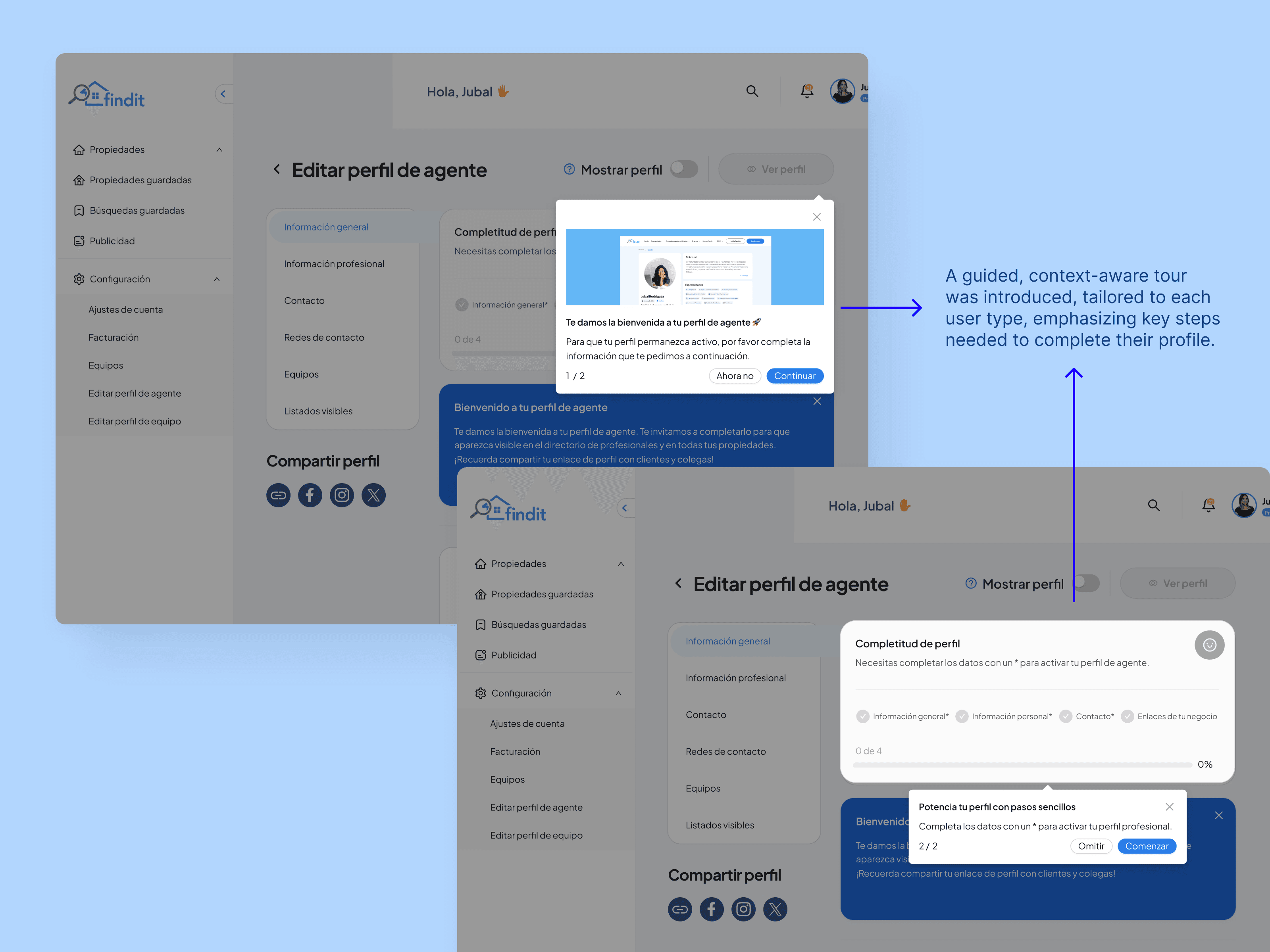
Since users lacked awareness of what the profile was for, I introduced a context-aware guided tour triggered at onboarding, not buried in settings.
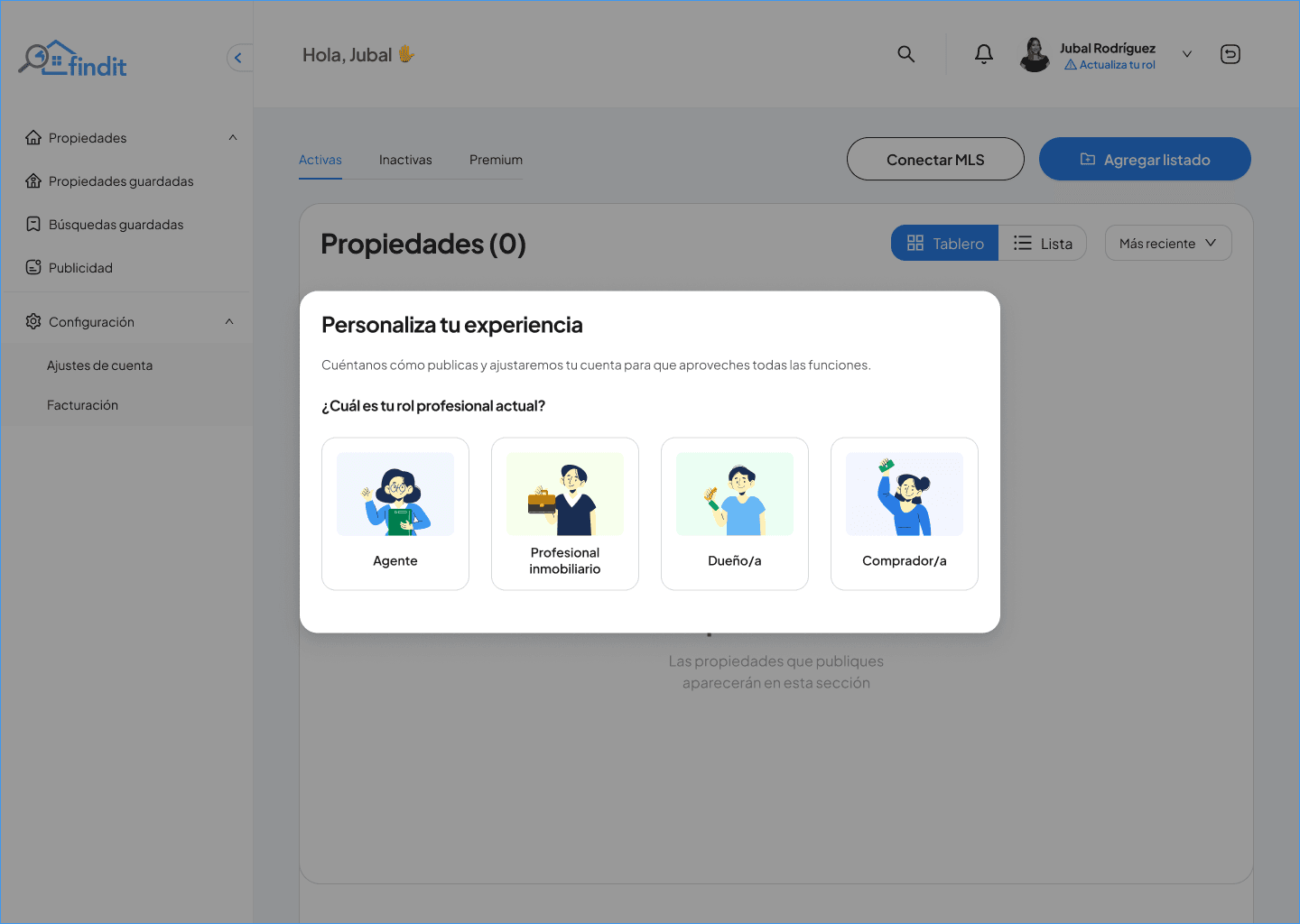
The tour was segmented by user type (independent agents vs. agency managers), emphasizing the steps most relevant to each. This reduced cognitive load while increasing perceived relevance from the very first session.

Benefit-first copy
Instead of asking users to "complete their profile," every touchpoint was reframed to lead with what they would gain: visibility on Google, trust before buyers call, credibility as a professional. The task became the vehicle; the benefit became the headline. This shift addressed the motivation gap directly, users who didn't see the value simply wouldn't act.

Zeigarnik progress bar
I applied the Zeigarnik effect by introducing a visible progress bar showing completion status and pending tasks. Incomplete tasks create psychological tension, users are more likely to return and finish something they've already started. The progress bar turned a one-time form into an ongoing loop of engagement.

Design iterations
Contextual onboarding guidance
We introduced guided onboarding patterns that explained:
why profile completion mattered,
how visibility worked,
and how professional trust impacted marketplace participation.
This shifted the experience from “fill out your profile” to “build your professional presence.”
What the data told us
The first interventions worked increasing 30 profiles, but observing the experiment closely revealed something we hadn't anticipated. A significant volume of users were still skipping activation, and recurring agents who already knew the platform weren't activating either.
Based on feedback the opportunity barrier was still present. Not because users didn't want to activate, because the moment we asked didn't match the moment they had capacity to act.
Design iterations
Iteration 01 — Remove the effort, not the value
Nudge:
Even when agents understood the value, filling in information felt like a task that required time they didn't have. We introduced auto-populated profiles so agents could activate with a single confirmation and refine their information later.
We stopped conflating activation with completion.
Iteration 02 — Let real agents do the convincing
Agents told us directly: having a profile meant appearing in search engines, sharing all their listings with one link, and not needing to invest in a website. We replaced generic platform copy with real agent testimonials inside the activation flow.
Peer validation is more persuasive than product messaging.

Iteration 03 — Put the control where the user already is
Activation was buried inside a settings flow. Recurring users had no visible way to act once onboarding was over. We added a toggle directly in the sidebar, always visible, one tap, from anywhere in the platform.

Results
• Based on analyitics, the first experiment resulted in 30 profile activations. After iteration, that number grew to 70, more than doubling the initial outcome.
• Agents who activated their profiles renewed their subscriptions at a higher rate, helping reduce churn and increase the lifetime value (LTV) of the platform’s most engaged segment.
• Agents also expressed satisfaction using their profile as a substitute for a personal website, appearing on Google search results and sharing their full portfolio with clients through a single link.
Key Takeaways